Is COVID-19 Making a Comeback — or Is This Part of a Seasonal Pattern?
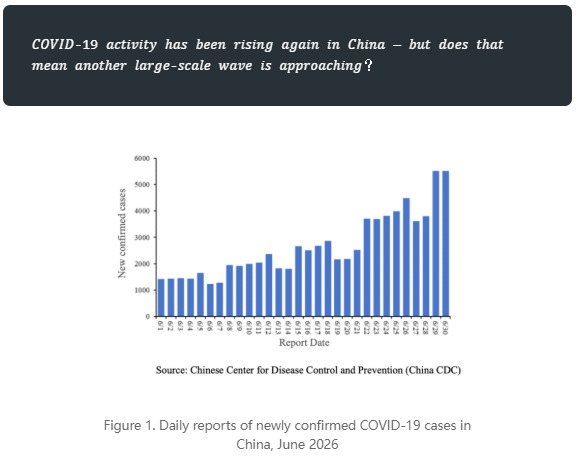 Recent surveillance data from the China CDC (Chinese Centre for Disease Control and Prevention) show a clear upward trend in June 2026. Across the country, 79,000 newly confirmed cases were reported during the month. Among influenza-like illness cases seen in outpatient and emergency departments, SARS-CoV-2 positivity rose from 2.9% in early June to 9.6% by early July, making it the second most frequently detected respiratory pathogen in these settings.
The increase is noticeable—but current evidence does not point to the start of another major pandemic wave. Instead, surveillance data and recent epidemiological research suggest that SARS-CoV-2 is increasingly showing a seasonal pattern, with infection activity tending to rise during both summer and winter. So far, there is no clear indication that the latest increase is being driven by a new high-risk variant or an unknown pathogen. The more likely explanation is that COVID-19 is entering another seasonal circulation period.
Not necessarily. One important change since the pandemic is that SARS-CoV-2 is gradually transitioning from pandemic behavior to a more seasonal transmission pattern. In the early stages of the pandemic, viral transmission was largely driven by a highly susceptible global population and widespread non-pharmaceutical interventions (NPIs).
Seasonal factors played only a limited role. Today, the situation is different. Population immunity has evolved through both infection and vaccination, while the virus itself continues to change. As a result, environmental conditions, seasonal factors, and human behavior are playing an increasingly important role in shaping transmission patterns.
Research published by the U.S. CDC shows that SARS-CoV-2 activity in the United States now follows a clear biannual seasonal pattern, with peaks typically occurring during July to September and December to February. Similar trends have also been observed in China. National surveillance data and multicenter epidemiological studies indicate increasing COVID-19 activity during May to July, suggesting that a summer transmission peak is becoming part of the virus’s seasonal behavior. Taken together, these findings suggest that the recent increase in COVID-19 cases is not an unexpected anomaly, but rather a reflection of the evolving epidemiology of SARS-CoV-2.

A common misconception is that hot weather alone should slow down viral transmission.
In reality, the seasonality of SARS-CoV-2 is far more complex. Current evidence suggests that COVID-19 transmission is influenced by the interaction of environmental conditions, human behavior, viral characteristics, and host immunity—rather than by temperature alone.
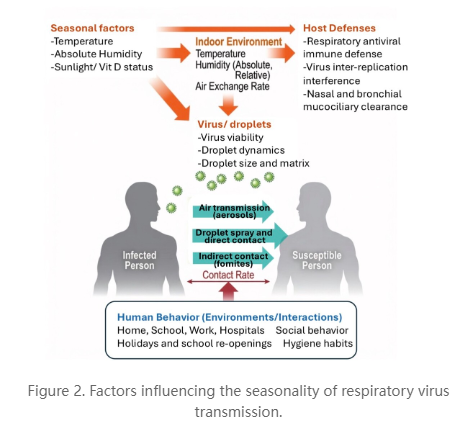
Adapted from: Moriyama M, Hugentobler WJ, Iwasaki A. Seasonality of Respiratory Viral Infections. Annu Rev Virol. 2020 Sep 29;7(1):83-101.
This explains why SARS-CoV-2 can continue circulating even during the summer months, despite higher temperatures.

Many people assume that warmer temperatures naturally reduce the spread of respiratory viruses. While environmental conditions do influence viral transmission, they do not determine it on their own.
Cold temperatures, low humidity, and reduced ultraviolet (UV) radiation can create conditions that favor the survival and transmission of respiratory viruses. These factors may also weaken respiratory mucosal defenses, making individuals more susceptible to infection.
However, SARS-CoV-2 behaves differently from many traditional seasonal viruses.
Research suggests that the relationship between temperature, humidity, UV radiation, and COVID-19 risk is not simply linear. In other words, higher temperatures do not automatically translate into lower transmission risk—and under certain conditions, infection risk may even increase.
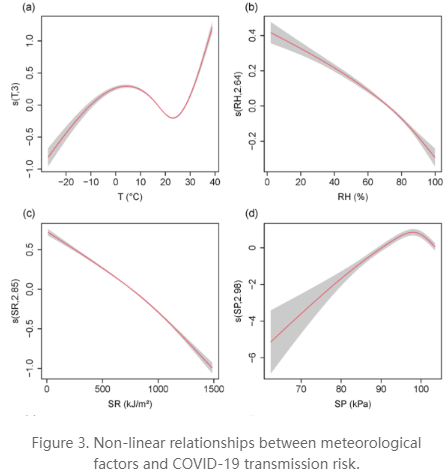
Adapted from: Zhang H, Wang J, Liang Z, et al. Non-linear effects of meteorological factors on COVID-19: An analysis of 440 counties in the americas. Heliyon. 2024 May 11;10(10):e31160.
These findings reinforce an important point: Weather is only one piece of the puzzle.
Population immunity, viral evolution, and human behavior all interact to shape transmission dynamics. As a result, SARS-CoV-2 can continue circulating—even during the hottest months of the year.

Summer isn’t just about warmer weather—it also changes how we live.
As temperatures climb, people naturally spend more time indoors in air-conditioned offices, shopping centers, public transportation, and homes. When ventilation is poor and close contact increases, these environments can create favorable conditions for viral transmission.
Good ventilation still matters—even in summer.

Weather is only part of the story.
Protection from previous infection or vaccination naturally decreases over time, while SARS-CoV-2 continues to evolve. New Omicron subvariants—including XBB, JN.1, and the currently circulating NB.1.8.1 lineage—have acquired improved immune-evasion capabilities, allowing continued transmission even in populations with existing immunity. This combination of waning immunity and viral evolution helps explain why periodic increases in COVID-19 activity can still occur—even during the summer months.

The good news is that the current increase is not being driven by a new high-risk variant.
The dominant strain remains Omicron NB.1.8.1 and its related sublineages, and public health authorities have not identified variants posing additional public health concerns.
Simple preventive measures still make a meaningful difference:
Wear a mask when appropriate in healthcare settings or crowded indoor spaces.
Practice good hand hygiene.
Improve indoor ventilation whenever possible.
Stay up to date with recommended vaccinations, especially for older adults and individuals at higher risk.

Most COVID-19 infections today cause mild upper respiratory symptoms, but some people remain at higher risk for severe illness.
If you develop symptoms such as fever, cough, sore throat, or fatigue:
Consider pathogen testing.
COVID-19 symptoms often overlap with influenza and other respiratory infections. Laboratory testing can help identify the cause and guide appropriate treatment.
Monitor your symptoms.
Most mild cases recover with rest, hydration, and supportive care. If symptoms worsen—or if you’re in a high-risk group—seek medical attention promptly.
Protect those around you.
Limit close contact while infectious, especially with older adults, young children, pregnant women, and people with chronic medical conditions. If you need to be around others, wear a mask and ensure good ventilation whenever possible.
References:
2.Chinese Center for Disease Control and Prevention. National COVID-19 Epidemic Situation (June 2026).
3.Rose EB, Paden CR, Cook PW, et al. Estimated COVID-19 Periodicity and Correlation with SARS-CoV-2 Spike Protein S1 Antigenic Diversity, United States. Emerg Infect Dis. 2025 Aug;31(8):1573-1579.
4.Wang XY, Zhang XX, Yang K, et al. Analysis of Pathogen Spectrum and Epidemiological Characteristics of Acute Upper Respiratory Tract Infections in Henan Province, 2024–2025[J]. Chinese Journal of Preventive Medicine, 2026, 60 (04): 566-572.
5.Zhang H, Wang J. Semiannual seasonality of COVID-19 with alternating peaks in winter and summer. Front Public Health. 2026 Jun 26;14:1877365.
6.Baker RE, Yang W, Vecchi GA, et al. Susceptible supply limits the role of climate in the early SARS-CoV-2 pandemic. Science. 2020 Jul 17;369(6501):315-319.
7.Moriyama M, Hugentobler WJ, Iwasaki A. Seasonality of Respiratory Viral Infections. Annu Rev Virol. 2020 Sep 29;7(1):83-101.
8.Ai JW, Deng KK, Dong M, et al. 2025 National Tertiary Clinical Respiratory Pathogen Surveillance Annual Report[J]. Chinese Journal of Infectious Diseases, 2026, Online Preprint.
9.Zhang H, Wang J, Liang Z, et al. Non-linear effects of meteorological factors on COVID-19: An analysis of 440 counties in the americas. Heliyon. 2024 May 11;10(10):e31160.
10.Cao Y, Jian F, Wang J , et al. Imprinted SARS-CoV-2 humoral immunity induces convergent Omicron RBD evolution. Nature. 2023 Feb;614(7948):521-529.
11.Wang Q, Qian J, Huang Q, et al. Overview of Epidemiological Characteristics of SARS-CoV-2 Reinfection[J]. National Medical Journal of China, 2023,103(12): 934-938.
12.Khoury DS, Cromer D, et al. Neutralizing antibody levels are highly predictive of immune protection from symptomatic SARS-CoV-2 infection. Nat Med. 2021 Jul;27(7):1205-1211.